
Last updated October 31, 2026
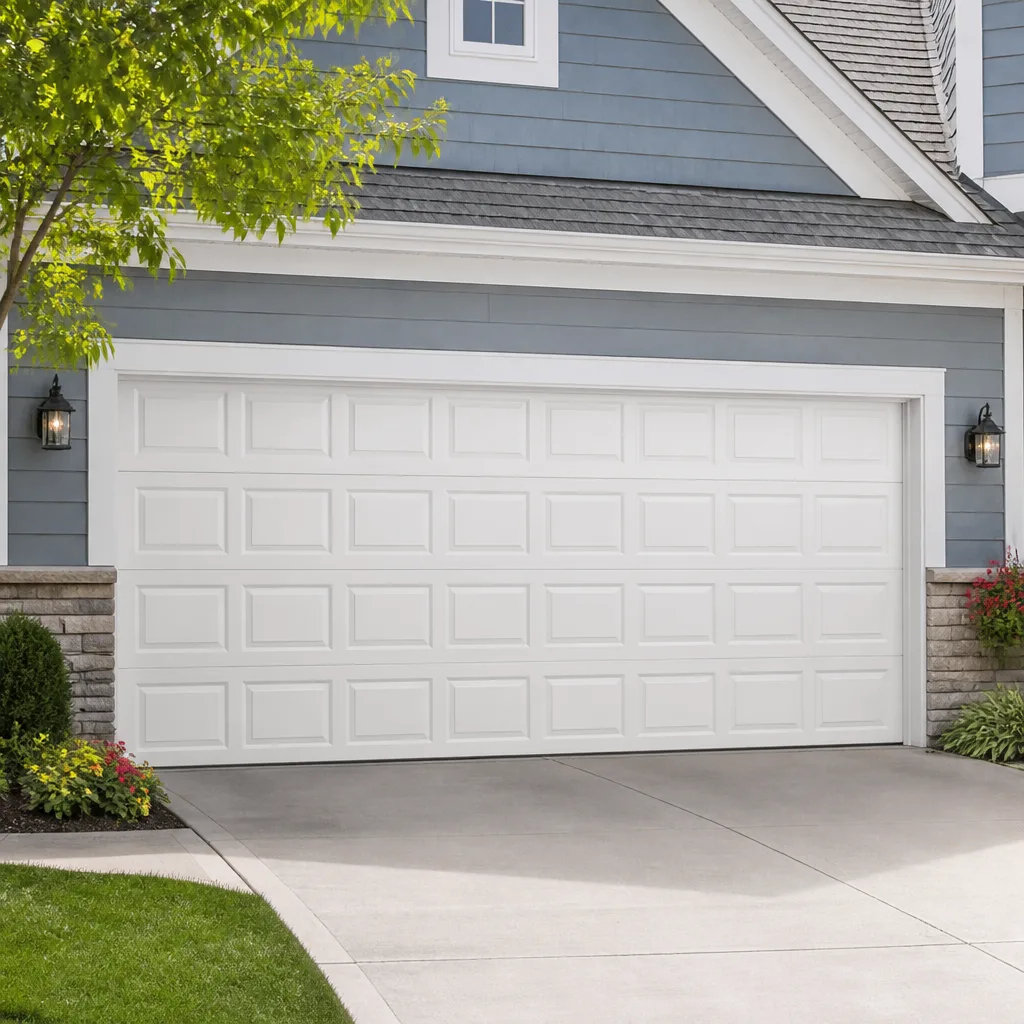 Raised-panel steel
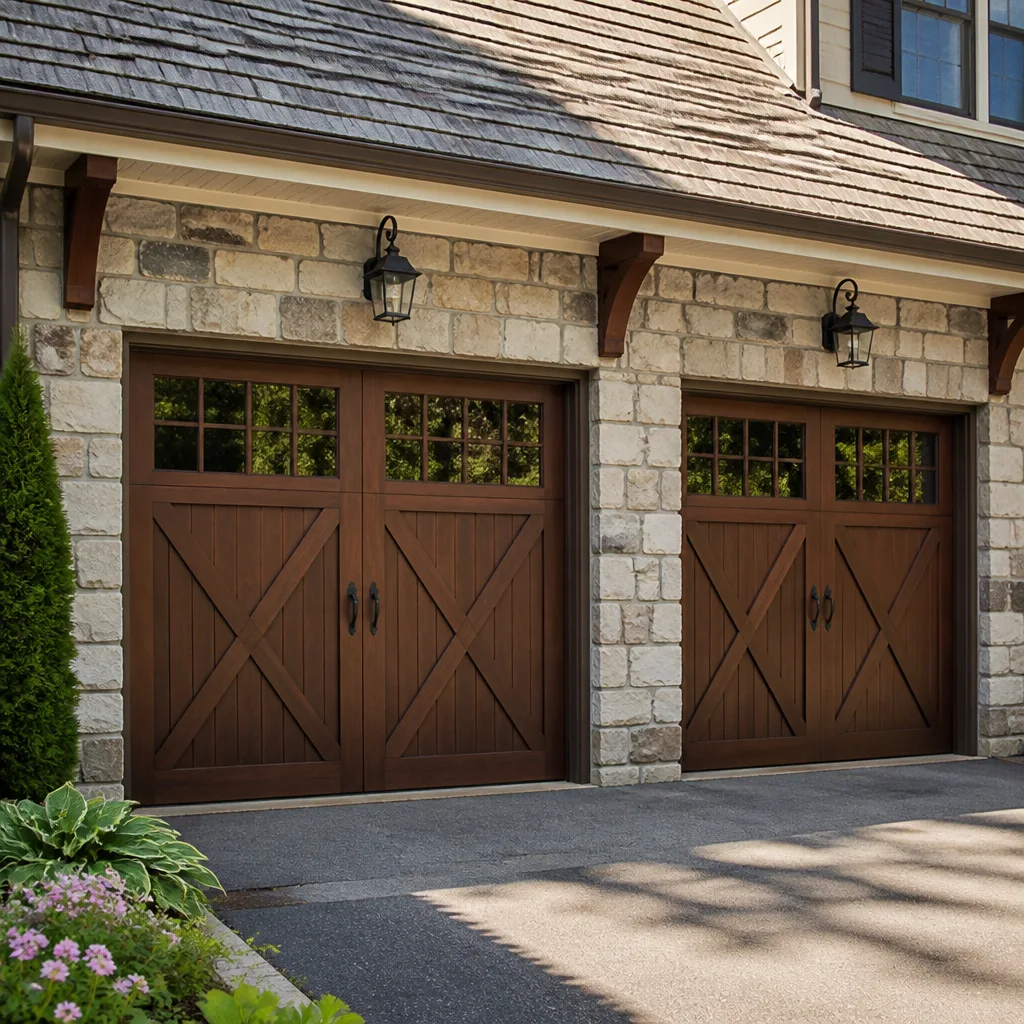 Carriage house
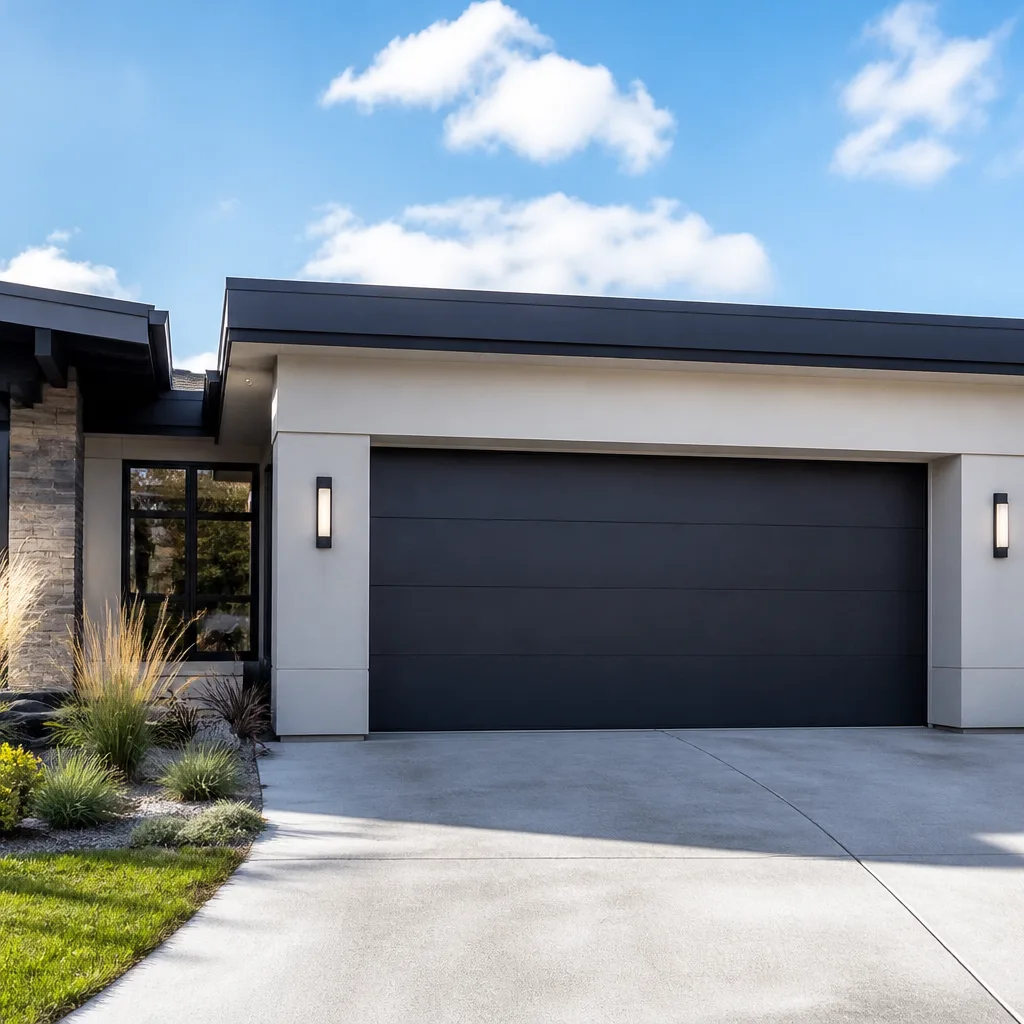 Modern flush
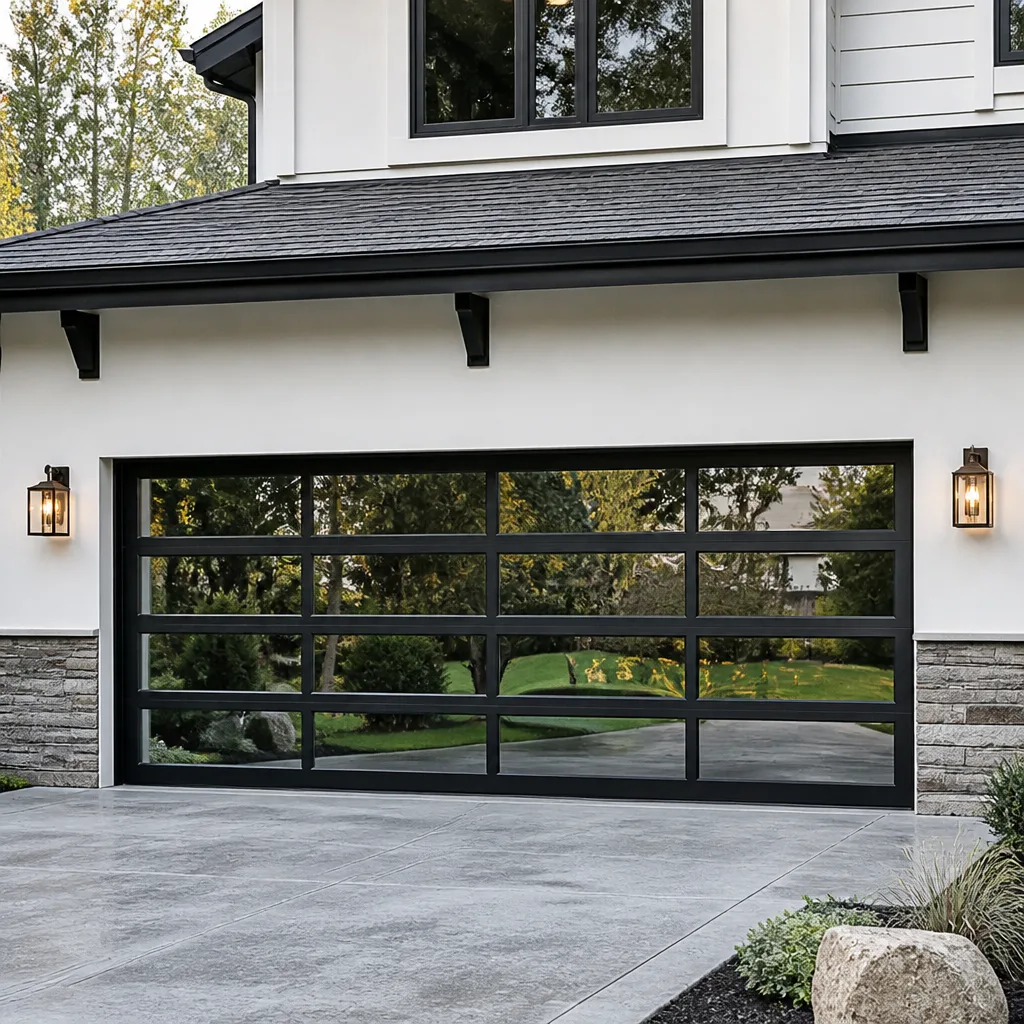 Full-view glass
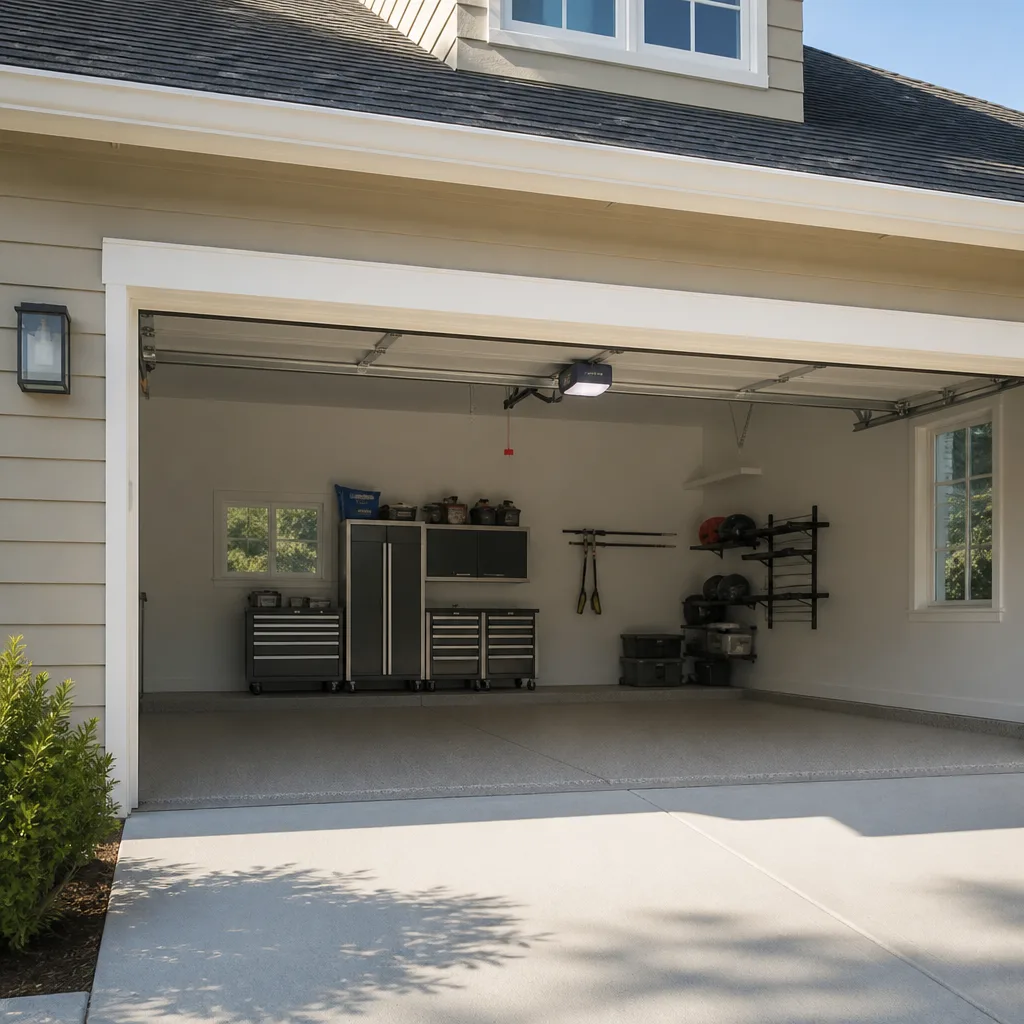 LiftMaster openers
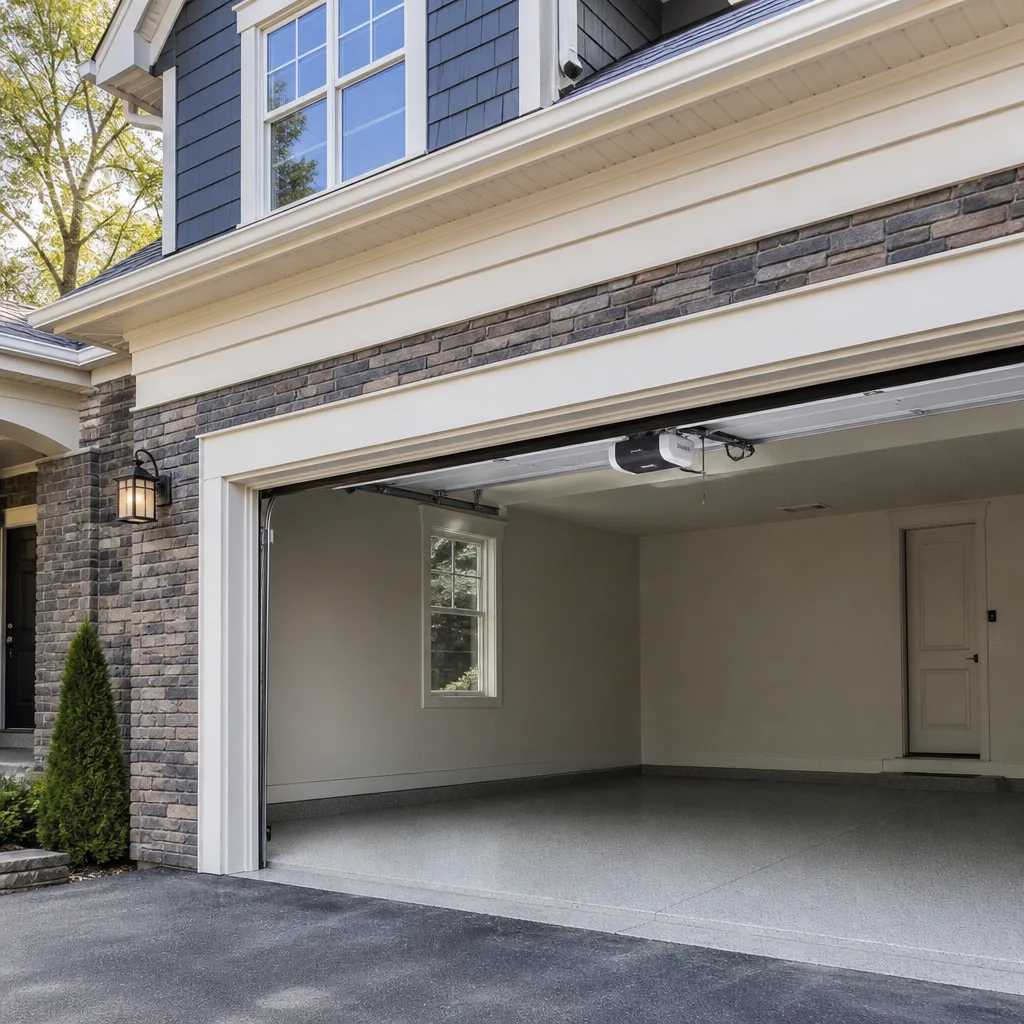 Chamberlain openers
Full 25-point door and opener safety check with every visit - springs, cables, rollers, tracks, and your LiftMaster or Chamberlain opener included
You get a price before we start. It does not change when the truck arrives.
Get your free estimateDIY vs Professional Garage Door: The Fort Pierce Homeowner’s Decision Guide
Every year, roughly 20,000 Americans land in emergency rooms from garage door injuries, and a disproportionate share of those injuries trace back to one component: the torsion spring. That’s the counterweight mechanism above your door, wound tight enough to lift several hundred pounds, and it does not care how handy you are. In Fort Pierce, the stakes run even higher than personal safety. Coastal wind-load codes, insurance paperwork, and salt-air corrosion mean a YouTube tutorial filmed in Ohio can leave you with a door that fails the next time a tropical system pushes through St. Lucie County.
This guide lays out exactly where the line sits between what a homeowner can safely handle and what needs a trained technician. You’ll learn which five tasks are genuinely safe to do yourself, which four you should never touch, how your windstorm insurance factors into the decision, and what a DIY mistake actually costs when it goes wrong.
Styles & brands we work with
Quick Answer
In Fort Pierce, DIY garage door work is safe for only a handful of low-risk maintenance tasks: lubricating moving parts, replacing weatherstripping, realigning photo-eye sensors, and reprogramming remotes. Anything involving torsion springs, lift cables, track realignment after an impact, or full door replacement should go to a professional, both because of the injury risk and because Florida Building Code wind-load compliance and insurance validity depend on licensed work. For most homeowners, the honest answer is: DIY the maintenance, call a pro for everything else.
Table of Contents
- The Fort Pierce Equation: Why This Decision Is Different Here
- The Short List: What’s Actually Safe to DIY
- The Hard Line: Where DIY Stops
- The Insurance Angle Most Guides Skip
- The YouTube Problem: Why Most Tutorials Don’t Apply in Florida
- The Real Cost of a DIY Job Gone Wrong
- Common Mistakes to Avoid
- When to Call a Professional
- Frequently Asked Questions
- The Bottom Line
The Fort Pierce Equation: Why This Decision Is Different Here
The DIY-versus-pro calculation changes when you live in a coastal Florida city. Most generic garage door advice online assumes a standard inland climate and no windstorm insurance rider to protect. Neither assumption holds in Fort Pierce.
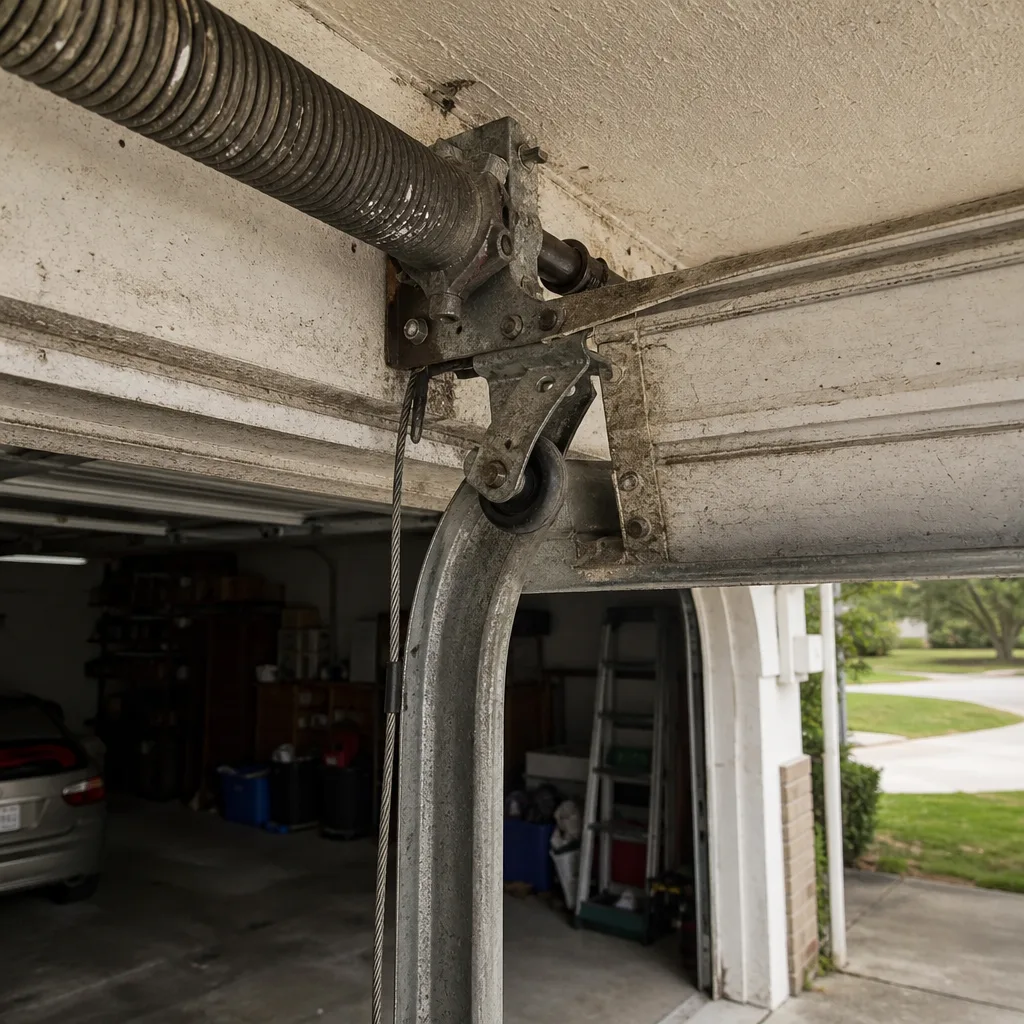
Start with the salt air. Fort Pierce sits on the Indian River Lagoon, close enough to the Atlantic that airborne salt reaches every piece of exterior hardware on your home. That includes garage door torsion springs, which are coated steel under constant tension. When that coating pits and the underlying steel begins to corrode, a spring that looks fine on the outside can snap without warning. We see this pattern constantly in older Fort Pierce neighborhoods like Lakewood Park and Indian River Estates, where doors installed in the 1990s and early 2000s are now reaching the end of their spring life cycles.
Then there’s the wind code. St. Lucie County enforces the Florida Building Code, which requires garage doors in wind-borne debris regions to meet specific design pressure ratings. A door that meets code has a sticker or plate documenting its wind-load rating and installation compliance. Replace that door yourself without a permit, and you’ve created a documentation gap that matters when you file a claim.
Add in the humidity, which accelerates rust on tracks, rollers, hinges, and cable hardware, and you have a maintenance environment that demands more attention than most national DIY guides acknowledge. The average Fort Pierce garage door operates in conditions that shorten hardware lifespan by 20 to 30 percent compared to inland installations.
This context matters because it redefines the question. You’re not deciding between DIY and professional based on skill alone. You’re deciding whether you can satisfy a building inspector, an insurance adjuster, and a windstorm event with the work you’re about to do. For certain tasks, that answer is clearly yes. For others, it’s obviously no.
The Short List: What’s Actually Safe to DIY
A handful of garage door maintenance tasks require no special tools, no tension exposure, and no permit. If you’re a Fort Pierce homeowner looking to save money without gambling, these five are the ones we’d suggest starting with.
1. Lubricating Moving Parts
Every six months, a few minutes of lubrication will keep your door running quietly and extend the life of rollers and hinges. Use a silicone-based or lithium-based spray on the hinges, rollers (the bearings, not the track), and the torsion spring coils. Avoid WD-40 for this job; it’s a solvent that displaces moisture but doesn’t leave a lasting lubricant film. In Fort Pierce’s humid climate, you want a product with corrosion inhibitors built in. Do this twice a year, and you’ll likely avoid the squeaks and grinding that signal premature wear.
2. Replacing Weatherstripping
The rubber strip along the bottom of your garage door takes a beating from the Florida sun and the daily grind of opening and closing. When it cracks, splits, or leaves daylight visible under the door, you’re inviting water, pests, and hot air into the garage. Replacement is genuinely simple: pull the old strip out of its channel and slide the new one in. You’ll find universal fit products at any hardware store in Fort Pierce, and the job takes about 15 minutes with no tools beyond a pair of scissors.
3. Realigning Photo-Eye Sensors
When your door reverses for no reason or refuses to close, the photo-eye sensors near the floor on each side of the opening are usually the culprit. A bump from a bike, a lawn chair, or a trash can knocks them out of alignment. The fix is usually as simple as loosening the wing nut, aiming the sensor at its partner, and waiting for the indicator light to go solid. This is a five-minute job you’ll do repeatedly as a Fort Pierce homeowner, especially if your garage doubles as the family storage zone.
4. Reprogramming Remotes and Keypads
Remote programming varies by opener brand, but every major manufacturer publishes simple instructions in the manual or online. If your remote stopped working after a power surge or a battery change, the fix usually involves pressing a learn button on the motor unit and then a button on the remote. We work on LiftMaster, Chamberlain, Genie, and Craftsman openers regularly, and the programming sequences are among the easiest homeowner tasks across all of them. This and the previous item govern our advice: we’d rather see a homeowner handle these five safe tasks confidently than attempt a spring job.
5. Tightening Loose Hardware
Garage doors vibrate. Hundreds of open-close cycles a year slowly loosen the bolts and nuts on hinges, brackets, and tracks. A socket set and about 20 minutes every six months will catch most of these before they become a problem. What you should not do is tighten anything connected to the spring system or the lift cables. Those components are under tension, and turning the wrong nut in the wrong direction can release that energy without warning.
These five tasks represent the realistic DIY ceiling for most Fort Pierce homeowners. They cover wear items, not structural or tension components. That’s where the hard line begins.
The Hard Line: Where DIY Stops
There are four garage door repairs where we draw a firm line as a professional company that has seen what happens when that line is crossed. These are not suggestions. They’re boundaries built from experience in Fort Pierce garages and from the injury statistics that keep emergency room doctors busy.
The Torsion Spring
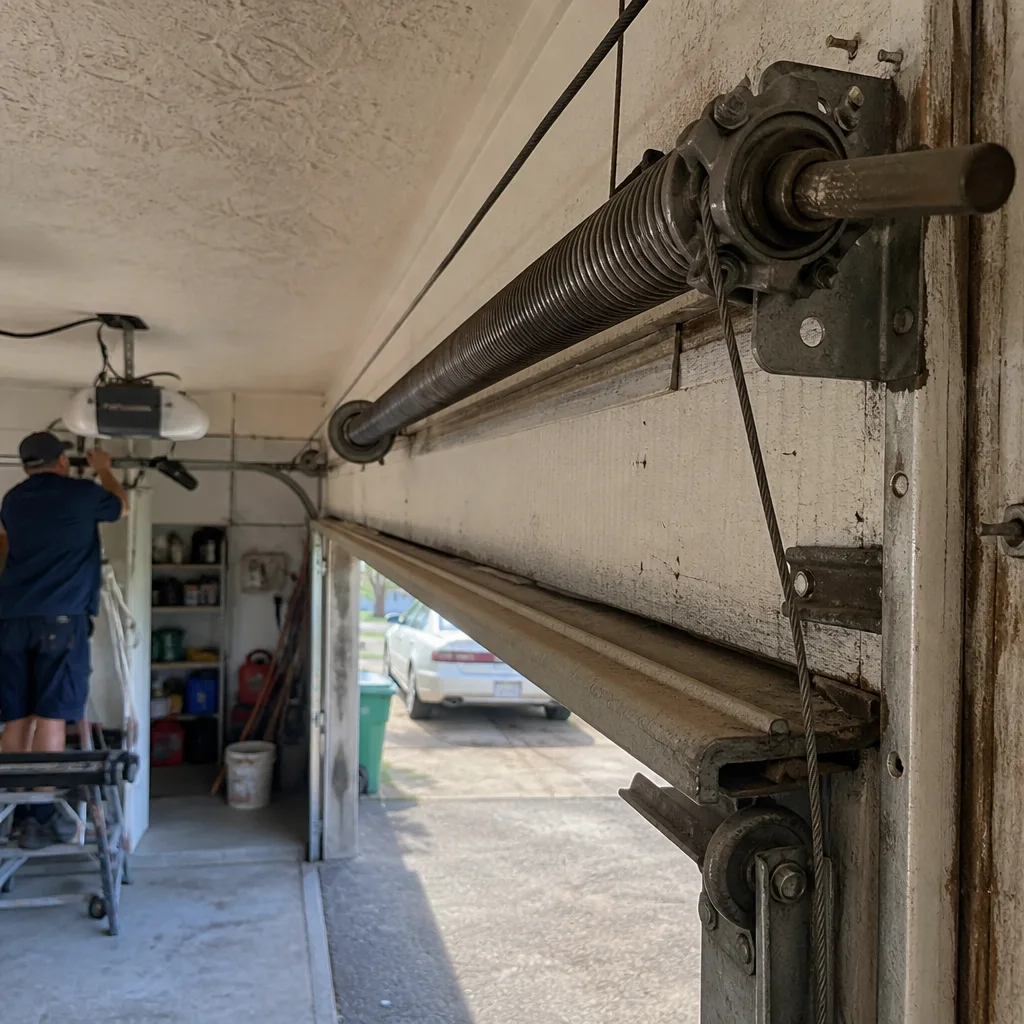
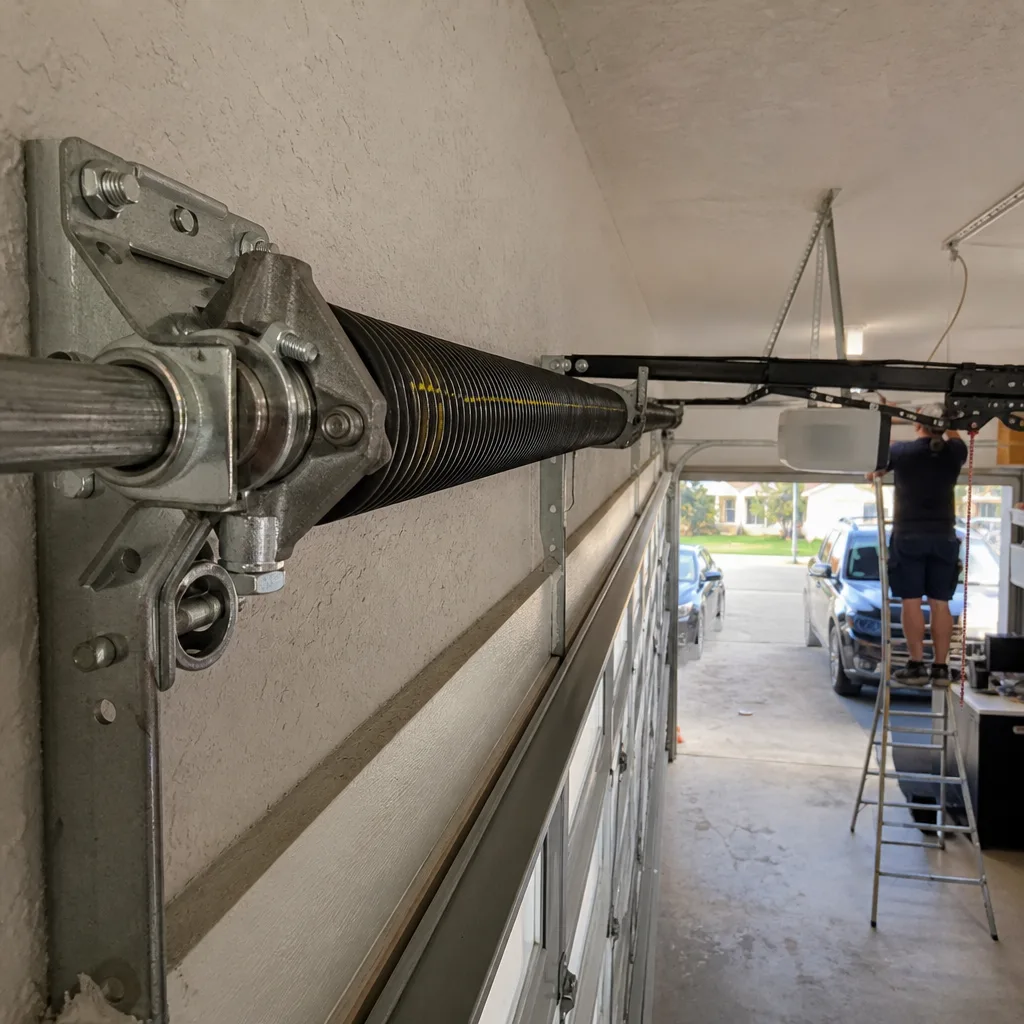
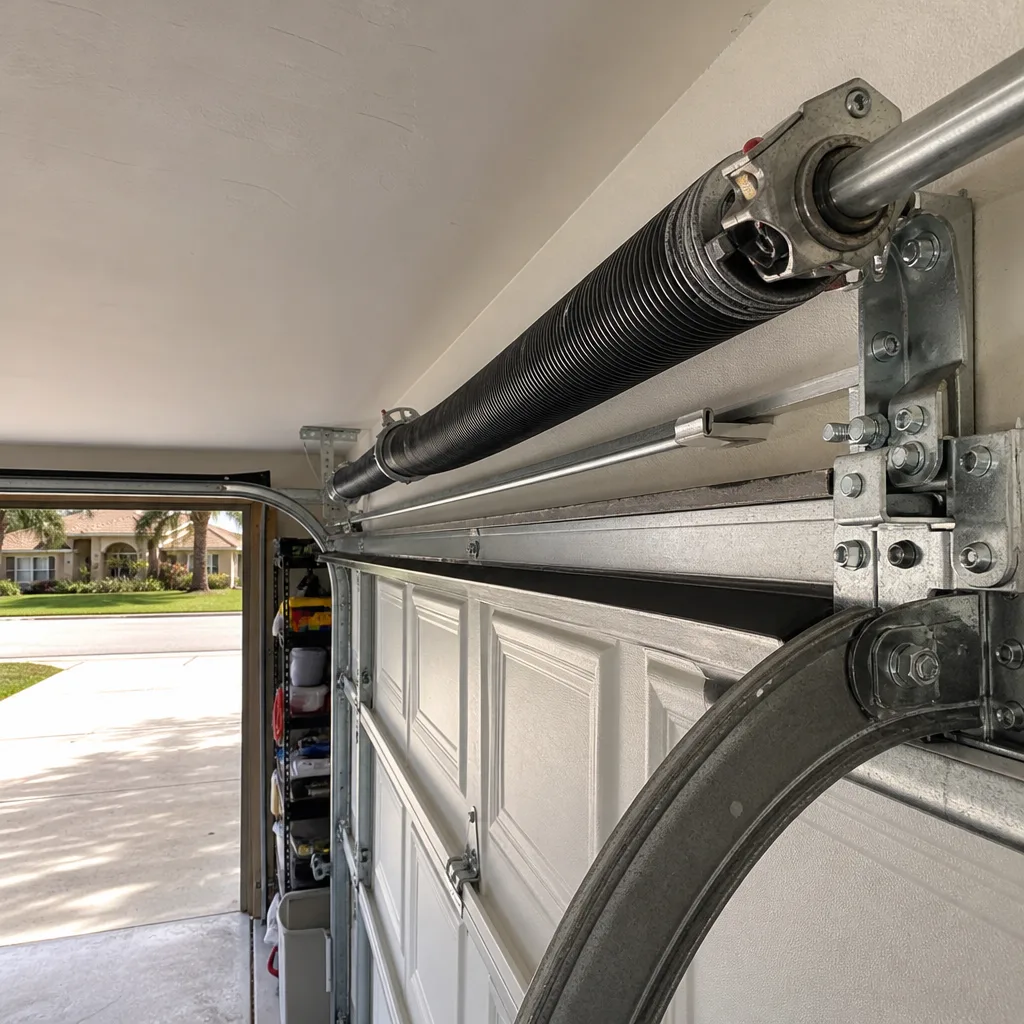
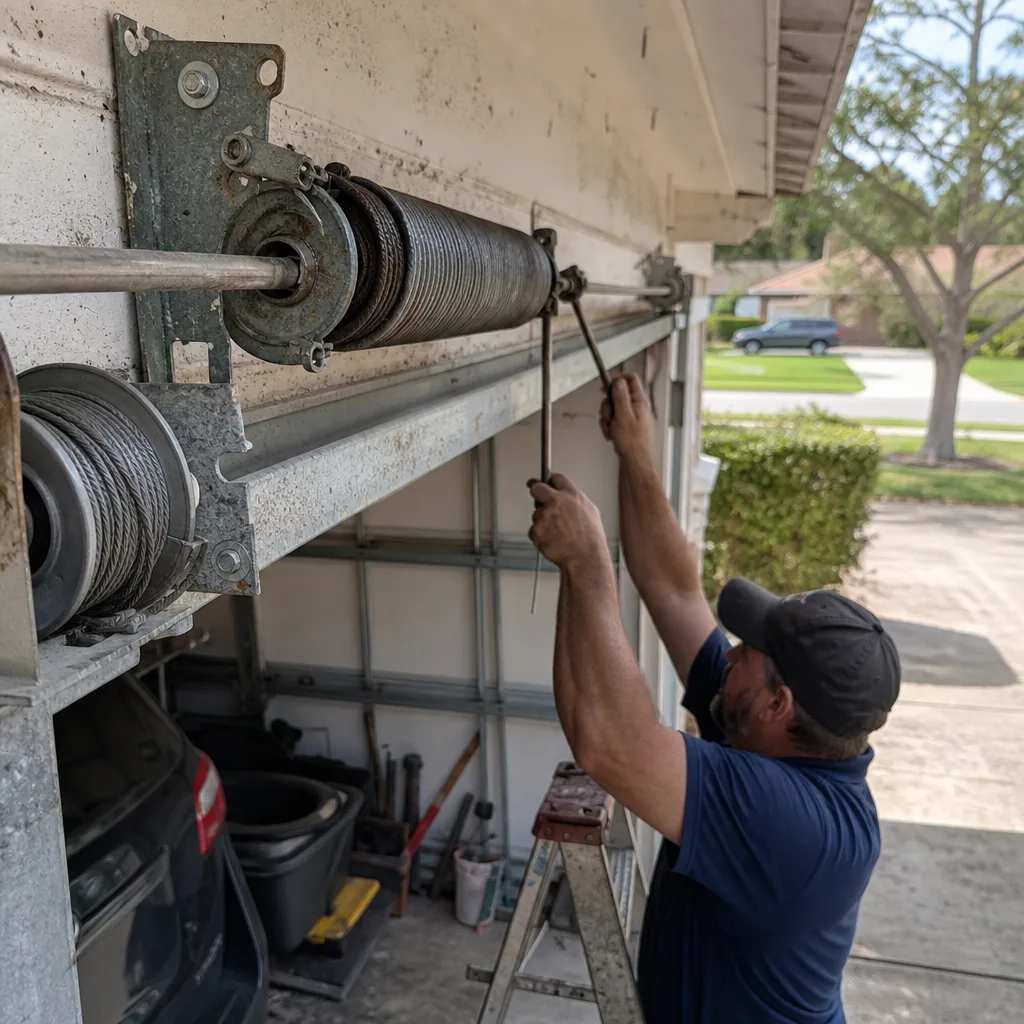
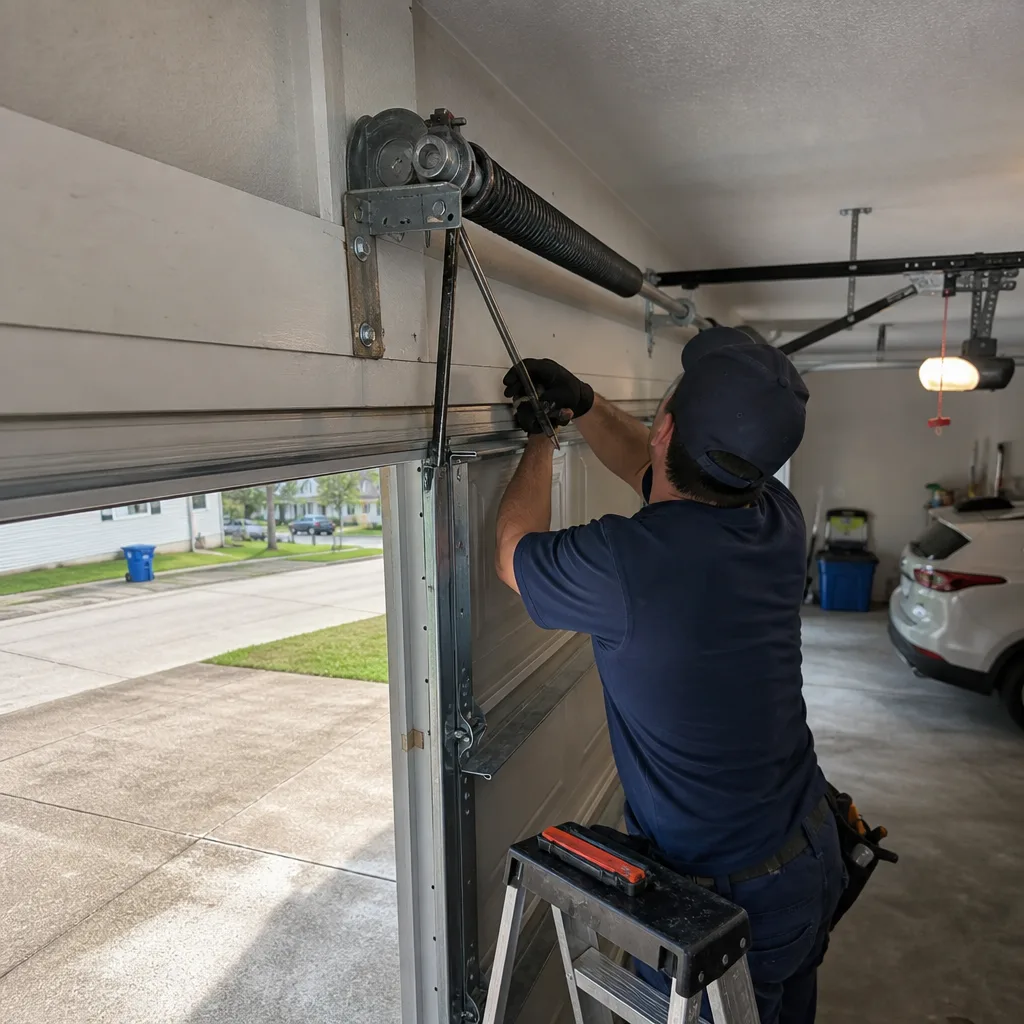
A torsion spring stores enough energy to lift a 200-pound door, which means it stores enough energy to break bones, sever fingers, or kill if it releases while you’re in its path. The winding and unwinding process requires specific tools, specific technique, and a real comprehension of how that energy behaves. This is the number one source of garage door injuries in the United States. If your spring is broken, you’ll usually hear it: a bang like a gunshot from the garage, followed by a door that won’t lift or lifts only a few inches. Do not touch it. Do not try to “just look at it.” A broken spring under residual tension can still move violently. Call a professional.
Lift Cable Replacement
The cables are the steel wires that run along each side of the door and do the actual lifting. They’re attached to the bottom brackets, which are attached to the spring system. When a cable frays or snaps, the door can drop unevenly, and a partially attached cable can whip across the garage under tension. Replacing a cable requires releasing the spring tension first, which loops you back into the same danger zone as the torsion spring. There is no safe way to do this job without the right training and tools.
Track Realignment After an Impact
If a car bumps the door, a hurricane pushes it inward, or a moving object bends the track, the repair is more than a matter of bending metal back. Impact damage usually means the door’s balance point has shifted, which puts uneven load on the springs and cables, and that creates a cascade of wear that fails later. A professional will realign the track, rebalance the door, and inspect the hardware for damage you can’t see from the ground. In Fort Pierce, where storms are a regular part of life, this is a repair that gets called in more often than any of us would like, which is why we also recommend reviewing our Garage Door Emergency Preparedness Guide for Fort Pierce Homes.
Full Door Replacement
Full door replacement in St. Lucie County requires a permit, wind-load compliance, and an installation that matches Garage Door Permits, Codes & Inspections in FL: What You Need to Know. You can technically buy a door from a big-box store and install it yourself, but you’ll be doing so without the documentation your insurance company will want to see after a windstorm claim. If the door fails during a storm because it wasn’t rated or installed correctly, the claim can be denied. This isn’t about skill. It’s about liability, paperwork, and the fact that a door is a structural element of a home in a wind-borne debris region.
Garage doors are all we do, and we’d rather tell you honestly where the line sits than watch a homeowner cross it. For Bay Area garage door concerns that go beyond these basics, our Garage Door Repair in Port Saint John team handles everything from broken springs to complete door overhauls in the region.
The Insurance Angle Most Guides Skip
Most DIY-versus-pro articles ignore insurance entirely, which is a strange omission for Florida, where windstorm coverage and hurricane deductibles are standard parts of every Fort Pierce homeowner’s policy. The insurance angle changes the DIY calculus in ways that matter to your wallet.
Here’s how it works in St. Lucie County. Your windstorm coverage is contingent on your home meeting the building code in force at the time of installation or replacement. When a professional installs a new garage door, the job comes with a permit and an inspection. That paperwork creates a record that the door is wind-rated, correctly fastened, and compliant. When a storm damages the door or the door fails and allows wind into the home, that record is what the adjuster looks for before approving the claim.
Install the door yourself without a permit, and that paperwork doesn’t exist. The adjuster’s next step is often to deny the garage door portion of the claim or to challenge the structural damage that resulted from the door failure. That’s not speculation. Insurance adjusters in Florida are trained to look for unpermitted work precisely because it’s a legitimate coverage exclusion. You’re not saving the few hundred dollars a professional installation would have cost if the result is a denied claim for far more than that.
The same logic applies, though with somewhat less weight, to spring and cable repairs. A door that falls because a homeowner replaced a spring incorrectly can cause the same interior wind damage as a door that fails structurally. If the adjuster determines the failure resulted from improper repair rather than the storm itself, your claim can be reduced or denied.
The point isn’t that you should never do anything yourself. It’s that the risk calculation includes a layer most guides omit: in Fort Pierce, your garage door is bound up in your insurance policy in ways that a homeowner in Missouri or Indiana never has to consider.
The YouTube Problem: Why Most Tutorials Don’t Apply in Florida
The internet is full of garage door tutorials, and most of them are filmed in states with no wind-load requirements, no coastal exposure, and no permit process for door replacement. That doesn’t make them bad tutorials. It makes them irrelevant for certain jobs in Fort Pierce.
Here’s how to evaluate a tutorial before you follow it.
- Check the location. If the person filming mentions a state that isn’t Florida, assume the tutorial doesn’t account for wind-borne debris requirements. This matters specifically for full door replacement, but it also affects hardware choices, fastener patterns, and track gauge.
- Look for a permit mention. Any legitimate Florida-specific tutorial that covers door replacement should discuss permits and wind-load ratings. If those words never appear, the person likely isn’t working in a Florida code jurisdiction.
- Watch the spring handling. For any video involving torsion springs, count the number of times the person mentions tension danger, winding bars, and the specific number of quarter-turns. If the video doesn’t show gradual winding with proper bars, you’re watching an accident waiting to happen.
- Check the comments. Sort by new and look for people saying the tutorial didn’t work or led to injury. The comment section is often more honest than the video.
- Ask the question directly. Will this door meet Florida Building Code if I do it this way? If you can’t answer that question confidently, the tutorial hasn’t given you enough information.
Most Fort Pierce garages are equipped with doors from major brands like Wayne Dalton, Amarr, and Craftsman, and while the mechanical basics are the same across states, the installation requirements are not. A Clopay door installed correctly in Ohio is the same door, but the anchors, the fasteners, and the code compliance that keep it attached to a Florida home in a category 2 storm are entirely different.
We work on your brand, whatever it happens to be. And in our experience, the tutorials that make spring replacement look easy are usually the ones that skip the two hours of careful, patient winding that the job actually requires.
The Real Cost of a DIY Job Gone Wrong
The easiest way to think about this is to compare the numbers honestly, including the ones most DIY discussions conveniently leave out.
A professional garage door spring repair in the Fort Pierce area typically runs between $180 and $340 depending on the spring type, the door weight, and the time of day, as detailed in our Garage Door Cost Breakdown: The Fort Pierce Homeowner’s Reference for 2026. That price includes the spring, the labor, the balancing, and a safety check of the rest of the system. You’ll have a door that works, a spring that’s balanced, and no trip to the hospital.
Now run the DIY scenario. A pair of torsion springs purchased from a hardware store or online runs $50 to $100. Add $20 for a pair of winding bars if you’re doing it the semi-correct way. So you’re in it for roughly $70 to $120 and a few hours of your weekend.
Here’s what happens when it goes wrong on the most common failure paths.
- Spring snaps during winding. A broken forearm, a fractured hand, or worse. Emergency room visits in Florida routinely run $1,000 to $3,000 with insurance, and far more without. A severe injury requiring surgery can exceed $20,000.
- Winding cone slips. The spring unwinds violently and damages the door panel, the opener, or the ceiling drywall. Panel replacement alone runs $200 to $600. An opener replacement runs $300 to $500.
- Spring installed with wrong number of turns. The door doesn’t balance. It’s heavy on the way up or crashes on the way down. The opener motor burns out from the extra load. You now need a spring redo plus an opener repair.
- Door drops because cables weren’t seated. A falling door is heavy enough to crush whatever is under it. That includes car hoods, children’s bikes, and unfortunately sometimes people.
The honest math is that a professional spring replacement costs a couple hundred dollars, while a DIY spring failure costs, on average across the ways it can fail, somewhere between $500 and $3,000 and occasionally far more. If you factor in the small but real chance of serious injury, the expected value of the professional route is clearly better for anyone who isn’t a trained garage door technician.
And for the homeowners doing the comparison shopping: a professional repair comes with a warranty and the knowledge that the spring is balanced to the door. The DIY version comes with a weekend of anxiety and a tension-loaded component you won’t trust for the first year.
For homeowners closer to the Osceola County side, the same math applies. Our Garage Door Opener Repair in Port Saint John page covers opener-specific issues, which are a different category from spring work but still best left to the pros.
Common Mistakes to Avoid
- Underestimating the torsion spring. This is the one that lands people in the ER. A spring under tension doesn’t warn you before it releases. The injury happens in the time it takes to blink.
- Skipping the permit on a full door replacement. In St. Lucie County, a new garage door is a permitted project. An unpermitted installation voids the code compliance record your insurance company will want to see. That’s a self-inflicted coverage gap.
- Following a tutorial filmed outside Florida. If the person teaching you isn’t working in a wind-borne debris region, the fastener schedule and hardware choices won’t meet Fort Pierce requirements for a replacement door.
- Using the wrong lubricant. WD-40 displaces moisture but doesn’t leave a lasting film. In Fort Pierce’s humidity, you want a silicone or lithium spray with corrosion inhibitors. The wrong product means you’ll be lubricating again in a month.
- Tightening anything near the spring system. The bolts on a spring anchor bracket are not like the bolts on your fence gate. Turning the wrong one can release stored tension. If you’re not sure whether a bolt is under tension, don’t turn it.
- Replacing only one spring when both are worn. Torsion springs wear at the same rate. If one has broken, the other is usually close behind. Replacing both resets the cycle count and keeps the door balanced. Replacing one means another service call soon.
- Ignoring the door’s balance after any repair. A door that’s out of balance puts extra load on the opener motor, which shortens its life. Any spring or cable repair should end with a balance check. Professionals include this by default. DIY repairs usually skip it.
When to Call a Professional
Call a professional in any of these situations: the spring is broken or visibly rusted; a cable is frayed or snapped; the door was hit by a car or battered by a storm; the door is being replaced entirely; or the opener is showing symptoms you can’t diagnose with a remote reprogram or a sensor realignment. These are the jobs where the risk and the stakes outweigh any plausible savings.
If you’re not sure where your situation falls, that’s what a free estimate is for. Palmetto Garage Door Service offers free estimates in Fort Pierce. Call (877) 265-2128 and describe what you’re seeing. From the opener to the panels, we’ll walk through the probable diagnosis and give you a number before any work starts.
For homeowners planning a full replacement, our Garage Door Installation in Port Saint John page covers the process, the brands we carry including Raynor and Wayne Dalton, and the wind-load compliance details that matter in St. Lucie County.
Frequently Asked Questions
Professional torsion spring replacement in Fort Pierce typically runs between $180 and $340, including the spring, labor, balancing, and a system safety check. The range depends on door weight, spring type, and whether you need one or both springs replaced. For an exact quote on your door, call (877) 265-2128. Estimates are free and the price is agreed before any work begins.
No. Torsion spring replacement involves stored mechanical energy strong enough to cause serious injury or death if released incorrectly. The winding process requires specific tools and training. This is the single most dangerous repair in residential home maintenance, and no amount of YouTube preparation makes it safe. Call a professional.
Yes. St. Lucie County requires a permit for full garage door replacement, and the installation must meet Florida Building Code wind-load requirements. A permitted installation creates the documentation your windstorm insurance claim needs. An unpermitted DIY installation voids that record and can result in a denied claim.
In most cases yes, provided the door was installed with a permit and documented wind-load compliance. If the door was installed without a permit, or if the adjuster determines that a DIY repair contributed to the failure, the claim can be denied or reduced. The paperwork from a professional installation is the difference.
Lubricate the hinges, rollers, and springs every six months with a silicone or lithium spray. Replace cracked or flattened weatherstripping when you see daylight under the door. Realign photo-eye sensors when the door refuses to close. Reprogram remotes after power surges. Tighten loose hardware that is clearly not part of the spring or cable system. Leave everything else to a trained technician.
A wind-load rated garage door carries a compliance sticker or plate, usually on the interior face of the door or on the track assembly. The label states the design pressure rating and installation date. If you can’t find a sticker and the door was installed before the current code cycle, a professional can tell you whether it meets current Fort Pierce requirements and what replacement options make sense.
Heat and humidity cause the metal in tracks and hinges to expand, and the extra load makes an aging opener motor work harder. If the opener is more than 10 years old and struggling only in summer months, the motor may be near the end of its life. A professional can tell you whether the fix is an opener repair or a full replacement. We handle LiftMaster, Chamberlain, Genie, and Craftsman openers.
The Bottom Line
The DIY-versus-pro decision for Fort Pierce garage doors comes down to a straightforward rule: handle the wear items yourself, and hand the tension, structural, and code-governed work to a professional. Lubrication, weatherstripping, sensor alignment, and remote programming are homeowner jobs. Torsion springs, cables, track realignment, and full door replacement are not. In Fort Pierce, the stakes include personal safety, Building Code compliance, and windstorm claim validity. That’s not a weekend project risk. That’s a home equity and hospital bill risk. When the job crosses the line, call a professional who can tell you honestly whether the repair or the replacement actually makes sense, and then back that advice with a written quote. For a free estimate in Fort Pierce, call Palmetto Garage Door Service at (877) 265-2128.
Written by the team at Palmetto Garage Door Service, serving Fort Pierce since 2018.
See the difference
 Before
 After
 Before
 After
 Before
 After